Can Mud-Brick Courtyards Cool a Warming City? Mohenjo-daro’s Passive Design Under Scrutiny

Photo by Photo by Noman Bukhari on Unsplash on Unsplash
As US cities plan for another season of extreme heat, the ruins of Mohenjo-daro are frequently invoked as a model of passive cooling. The comparison is tempting: a Bronze Age city in the Indus Valley, built largely of baked and mud brick, arranged around courtyards, and occupied in a climate with punishing summers. But the phrase ancient air conditioning does more rhetorical work than archaeological work. Mohenjo-daro had no mechanical cooling, and its builders left no instruction manual. What survives is architecture, and what we infer from it must be sorted carefully into evidence, reasonable inference, and modern wishful thinking.
What the Ruins Actually Show
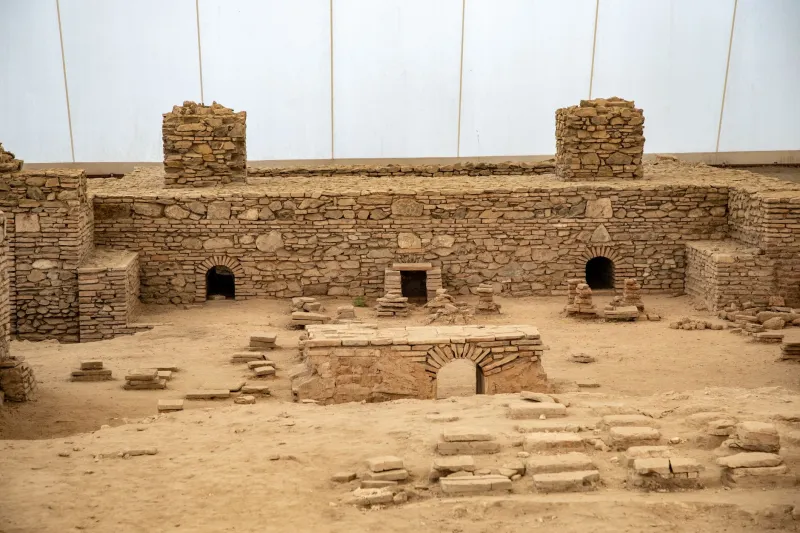
Mohenjo-daro flourished in the third and early second millennia BCE, roughly between 2500 and 1900 BCE, on the floodplain of the Indus River in what is now Pakistan. Excavations since the 1920s have revealed a planned city with streets and lanes, dense blocks of houses, extensive drainage, and a citadel mound with monumental structures. The residential areas are especially relevant to heat: many houses cluster around open courtyards, with rooms opening inward and walls shared with neighbors. Baked brick was used where durability and moisture resistance mattered, while mud brick appears in other parts of the fabric.
Those facts are well documented. What is not documented is a complete ancient roof, a preserved window schedule, or an inscribed explanation of how a house was meant to breathe. Mohenjo-daro’s ruins are partial, and reconstructions of its domestic comfort depend on analogies from surviving architecture, climate data, and experiments. That does not make the lessons worthless. It does mean that claims should be stated with precision.
The Courtyard as a Thermal Machine
A courtyard is not automatically cool. In a hot, dry climate, however, it can perform several useful functions at once. High surrounding walls cast shade during much of the day. At night, the open top allows warm air to rise and escape while cooler air settles into the court. Dense masonry can absorb heat during the day and release it slowly after sunset, smoothing indoor temperature swings. The courtyard also admits daylight and air without exposing the interior directly to the street.
At Mohenjo-daro, the courtyard is best understood first as a domestic space: a private open area for work, cooking, storage, and social life. Its thermal behavior is a consequence of form and material, not necessarily a designed engineering system. Modern studies of courtyard buildings in arid regions show that performance varies widely with courtyard proportions, wall height, orientation, surface color, vegetation, and the size of openings. A shallow, paved court behaves differently from a deep, planted one. Without surviving roofs and detailed finishes, no one can calculate the exact comfort of a Mohenjo-daro house.
Thick Walls, Slow Heat
Thick brick walls are among the most defensible lessons from the site. Mass delays heat transfer. A heavy wall exposed to afternoon sun can keep interior surfaces cooler for hours, then release stored heat overnight. In a climate with significant day-night temperature swings, that delay can improve comfort. In a humid climate with little nighttime relief, the same mass may simply hold heat.
This is why US desert cities have long studied adobe and other high-mass traditions, not because Mohenjo-daro directly influenced them, but because similar problems invite similar solutions. The Indus case reinforces a principle rather than supplying a blueprint: mass must be paired with shading, nighttime ventilation, and appropriate insulation. A thick wall alone is not a cooling strategy. It is a timing device.
Shade as Infrastructure
Shade at Mohenjo-daro was not limited to courtyards. Narrow lanes, adjoining buildings, and recessed doorways would have produced a shifting pattern of shadow through the day. Rooftops, reached by stairways in many houses, offered another level for sleeping and work during hot nights. Some popular accounts add leafy trees and arcades to this picture. Archaeobotanical evidence can tell us about plants used and grown, but it does not justify imagining a green canopy over every street.
The stronger point is geometric. Urban form itself can reduce exposure. US cities now debate tree canopy, cool pavements, shaded bus stops, and building setbacks in much the same spirit. Mohenjo-daro suggests that shade should be treated as shared infrastructure, not merely as a private amenity. It also offers a warning: access to shade in the ancient city probably varied with household wealth and status. Romanticizing the past can obscure the inequalities that a modern heat plan must address.
The Ventilation Question
Claims about roof-level vents, wind scoops, and air shafts at Mohenjo-daro should be handled with caution. Some are plausible inferences from later architecture in South Asia and the Middle East; others are retrofitted fantasies. The archaeological evidence for purpose-built wind catchers at the site is thin. Roofs have not survived intact, and openings are difficult to reconstruct from collapsed debris.
What can be said is that courtyards, limited exterior openings, and rooftop access could support nighttime ventilation and heat dispersal. Whether households managed these spaces as a coordinated cooling system is another matter. The difference matters for modern designers, because a principle such as night flushing can be tested and adapted, while a romantic legend cannot.
From the Indus to Phoenix and Philadelphia
US cities facing extreme heat do not need to imitate Bronze Age houses. They need reliable, code-compliant, equitable cooling. Courtyard logic can inform low-rise schools, libraries, clinics, and housing clusters, especially where shaded outdoor space and cross-ventilation reduce reliance on air conditioning. Thick masonry and deep shade can complement trees, reflective roofs, and efficient mechanical systems. None of these should replace cooling centers or emergency plans for vulnerable residents.
The honest lesson from Mohenjo-daro is modest but useful. Its builders worked with climate rather than against it, using mass, enclosure, shadow, and open sky. In 2026, as heat waves test US infrastructure, that approach deserves study without exaggeration. The ruins can teach us about passive cooling, but only if we let the evidence speak and resist turning an ancient city into a modern product label.