Ritual Pool or Public Cistern? The Enduring Mystery of the Great Bath
Of all the structures unearthed at Mohenjo-daro, none has captured the imagination quite like the Great Bath. Rising from the heart of the citadel mound, this sunken tank of finely fitted brick has invited nearly a hundred years of speculation. For American readers accustomed to thinking of ancient public baths in Roman terms—marble halls, socializing, hygiene—the Great Bath demands a different frame of mind entirely. Its purpose remains genuinely contested, and the debate tells us as much about archaeology as it does about the Indus Valley civilization itself.
A Structure Built to Hold Water
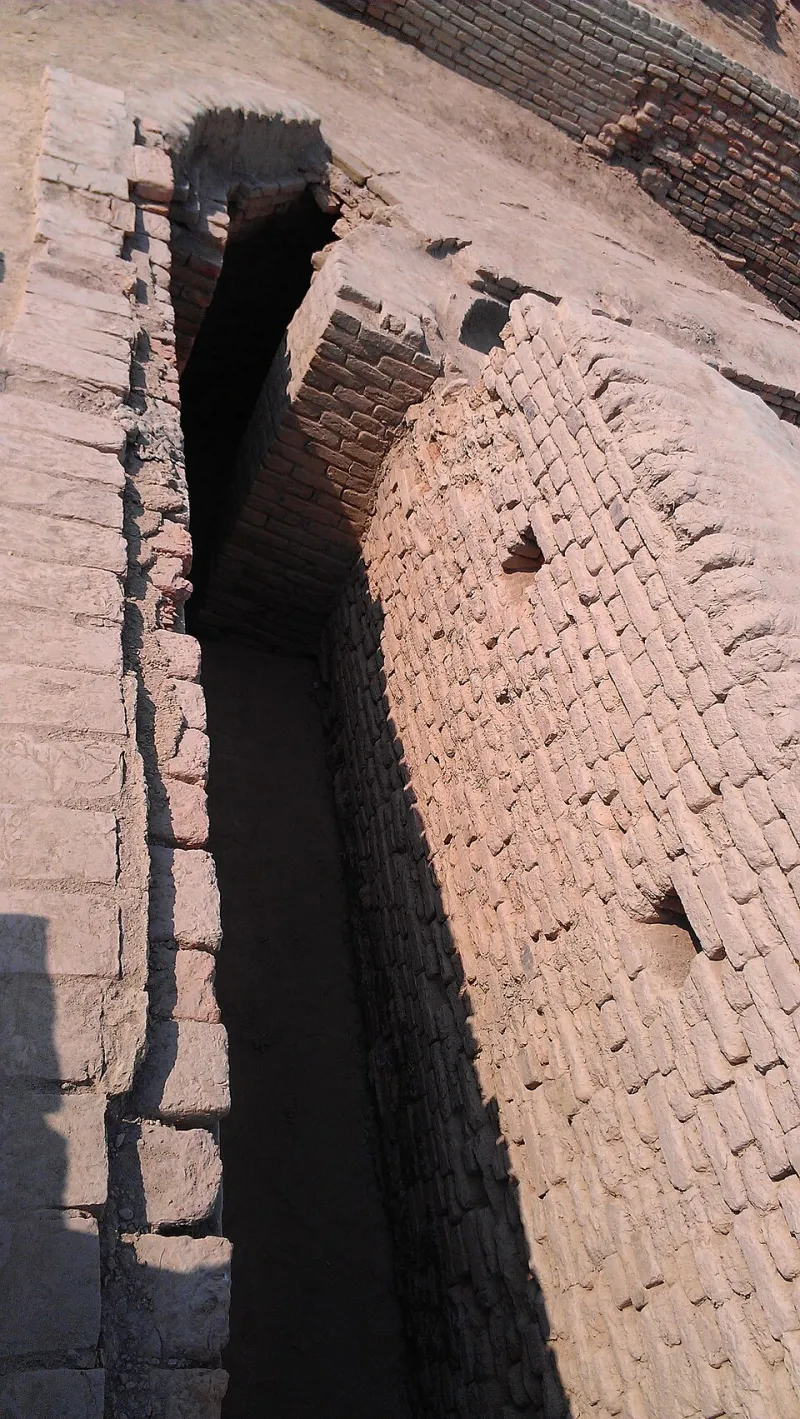
Start with the fundamentals, because the engineering alone narrows the field of plausible explanations. The central tank measures roughly 12 meters long by 7 meters wide and descends about 2.4 meters below the surrounding courtyard. Two broad staircases, one on the north side and one on the south, lead down into the basin. A thick bitumen lining sandwiched between layers of brick made the tank watertight—a remarkable feat for the third millennium BCE.
Water was supplied by a large well nearby and drained through a corbelled conduit that could be opened to empty the pool. Surrounding colonnaded galleries and small private rooms suggest the complex was a managed, purposeful space, not an accidental collection of ruins. Whoever built it invested enormous resources in one thing: keeping a large volume of water contained, clean, and controllable.
The Ritual Purification Theory
The dominant interpretation, advanced by the site's original excavator John Marshall in the 1920s and still widely taught, holds that the Great Bath served a ceremonial function. The reasoning follows several threads.
First, the location is telling. The bath sits on the citadel mound, the elevated precinct of the city, separated from the lower town where ordinary daily life unfolded. Monumental placement usually implies communal or sacred significance.
Second, water has deep ritual resonance in South Asian religious tradition. The practice of immersing in sacred tanks and rivers—visible today at sites from the ghats of Varanasi to the Kumbh Mela—has ancient roots. Many scholars see the Great Bath as an early expression of the same impulse: purification through water, possibly tied to festivals attended by pilgrims from across the Indus realm.
Third, the private rooms flanking the complex may have housed priests, attendants, or elite participants. The single monumental bath, rather than many small ones, suggests collective ceremony rather than casual recreation.
The Skeptics' Case
Not everyone is convinced. A rival line of thinking emphasizes practicality: perhaps the Great Bath was an elaborate water management facility—a storage cistern, a symbol of civic abundance, or even a component of flood control on a riverine plain that regularly dealt with the Indus's moods.
Critics of the ritual theory point out that no altars, idols, inscriptions, or clearly religious artifacts were found in or around the tank. Unlike Mesopotamian or Egyptian temples, the complex lacks any iconography declaring its purpose. The Indus script, wherever it appears, has never been decisively deciphered, so no ancient label survives to settle the question. In a civilization famously reticent—no grand royal tombs, no victory steles, no triumphant art—the absence of evidence cuts in multiple directions.
There is also the matter of scale. A tank this size, lined with expensive bitumen and fed by a dedicated well, represents a major municipal investment. Some archaeologists argue that such spending reflects the political importance of water infrastructure in an agricultural society, much as American cities once poured resources into grand public reservoirs and bathhouses that were equal parts utility and civic pride.
Comparisons Across the Ancient World
Placing the Great Bath in a wider context sharpens the picture. The Indus structure predates the famous Roman thermae by more than two millennia, and the two are barely comparable in spirit. Roman baths were social engines—venues for exercise, business, and gossip, heated by hypocaust furnaces and decorated with statuary.
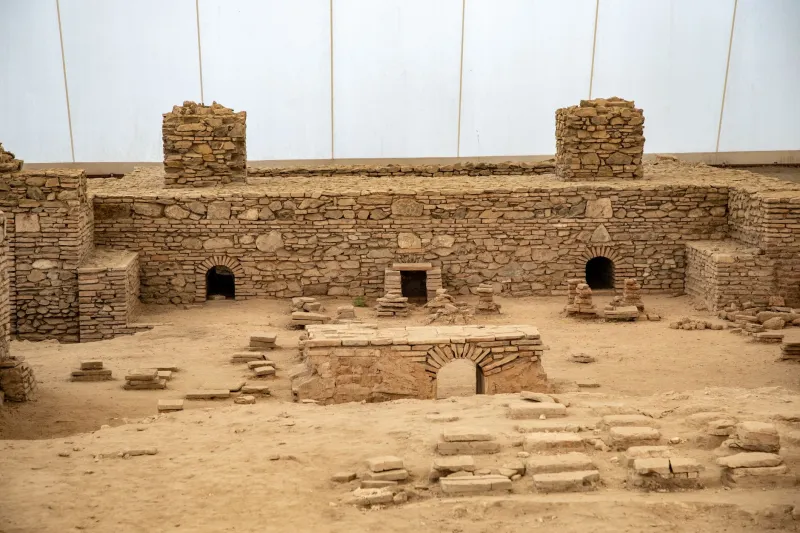
Closer parallels appear in later South Asian tradition. The stepped temple tanks (kalyani) of southern India, and the fire temples and bathing enclosures of later eras, echo the Great Bath's basic grammar: a sunken basin, staircases for controlled entry, surrounding galleries for spectators or participants. Elamite and Achaemenid sites in western Asia also contain ceremonial basins, hinting at a broader ancient Near Eastern culture of ritual water.
What distinguishes Mohenjo-daro is its early date and its solitude. Nothing else in the Indus repertoire matches the Great Bath's monumentality, which suggests it was unique in its own time—perhaps the defining institution of the city.
What the Bath Reveals About Indus Life
Whatever its exact function, the Great Bath tells us something important about the people who built it. A society capable of organizing this construction—coordinating brickmakers, waterproofers, laborers, and water managers—was clearly hierarchical or at least highly coordinated, despite the absence of palaces and kings in the archaeological record.
The structure also suggests that shared ritual or civic experience sat at the center of Indus urban identity. Where other civilizations expressed power through conquest and monuments to rulers, Mohenjo-daro appears to have expressed it through standardization, planning, and collective spaces. The Great Bath may be the closest thing we have to the soul of the city.
A Mystery Worth Keeping
Archaeology rarely delivers verdicts; it delivers better questions. The Great Bath may one day yield its secrets through new methods—residue analysis, refined dating, or fresh excavation at Mohenjo-daro, which has been only partially uncovered. Until then, the tank sits in the Sindh landscape, brick by perfect brick, holding its silence as gracefully as it once held water.
For students and history enthusiasts, that silence is an invitation. The Great Bath reminds us that the ancient world was full of sophisticated minds whose priorities did not always match our assumptions. Sometimes the most honest answer to "what was it for?" is simply: we are still finding out.