A Monument in Search of a Function: Rethinking Mohenjo-daro's 'Great Granary'
Visitors to Mohenjo-daro often meet the 'Great Granary' before they understand how little the name settles. The structure sits on the citadel mound, a broad expanse of brickwork whose scale invites grand explanations. In textbooks, museum panels, and classroom maps, the label implies a familiar story: an ancient city gathered grain, stored surplus, and supported a centralized administration. That story may be right. It may also be incomplete. The more useful lesson for students of archaeology is that the name is a hypothesis wearing the clothes of a fact.
A Convenient Name from an Earlier Era
When excavators in the 1920s uncovered the massive platform and associated brickwork, they were working without the analytical tools that modern archaeology takes for granted. They had no phytolith studies, no residue analysis, and no fine-grained chronology from radiocarbon dating. What they had was architecture, comparison, and intuition. The structure's size suggested public purpose; its raised platform and channels suggested ventilation; its position on the citadel suggested civic importance. The term 'granary' offered a compact explanation that fit contemporary ideas about ancient cities and centralized economies.
The label was not the product of a single eureka moment. It accumulated authority through repetition. Guidebooks needed a name. Survey courses needed a bullet point. Site plans needed a caption. Over time, the quotation marks around 'granary' tended to disappear, and an interpretive proposal became a shorthand for an entire economic system.
What the Architecture Can and Cannot Say
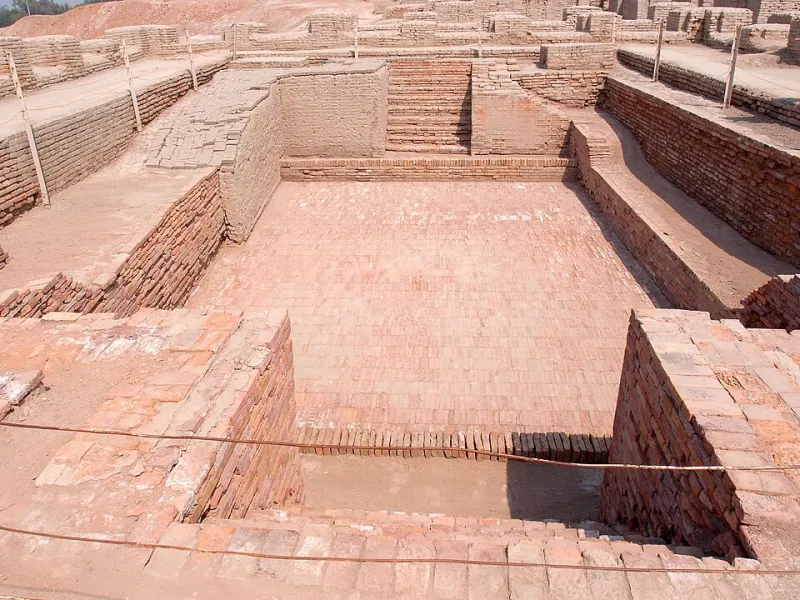
The structure's remains are impressive but ambiguous. A large brick platform could have supported a raised floor for storage, keeping grain dry and ventilated. It could also have served as a podium for a substantial building whose perishable superstructure has vanished. The surviving masonry tells us about construction, scale, and spatial relationships. It does not, by itself, tell us what moved across the platform or who controlled it.
This distinction matters. Archaeologists routinely infer function from form, but the inference is strongest when multiple independent lines of evidence converge. A granary hypothesis would be strengthened by recovered cereal remains, storage bins, loading areas, spillage patterns, or tools associated with weighing and redistribution. It would also benefit from evidence of controlled access and enough capacity to matter at a civic scale. Some of these conditions can be tested; others remain frustratingly silent.
No unequivocal cache of wheat or barley has been recovered from the structure to settle the question. Absence of evidence is not proof of absence—ancient organic materials often decay—but it does mean that storage remains an inference rather than a demonstrated fact. The same caution applies to the channels and voids in the brickwork. They may reflect ventilation, drainage, or construction technique. Each possibility carries different implications for how the building worked.
Storage, Ritual, or Administration?
The storage case is the most familiar. A city as large and dense as Mohenjo-daro needed mechanisms for moving food, managing risk, and supporting specialists. A central granary would fit models of taxation, tribute, and redistribution. The difficulty is that the Indus civilization has left no readable administrative archives and no royal inscriptions to confirm how such systems operated. The granary label fills a gap that the evidence itself does not fully close.
A ritual interpretation has also been proposed. The structure's location on the citadel, near other monumental features, has encouraged comparisons with ceremonial architecture. But proximity is not proof. Ancient cities often placed storage, administration, and ritual in the same elevated precinct, precisely because all three depended on civic authority. A building can be ceremonial without being a temple, and administrative without being a palace.
A third possibility is that the platform supported a multipurpose civic building—part warehouse, part assembly space, part symbol of collective capacity. This is less tidy than 'granary,' but it may be more honest. Indus urbanism does not always map neatly onto the categories inherited from Mesopotamia or Egypt. Students in U.S. survey courses are often taught to look for kings, temples, and palaces. Mohenjo-daro repeatedly resists that checklist.
Why Labels Outlive Their Theories
Archaeological names persist for reasons that are social as much as scholarly. A memorable label helps visitors navigate a ruined landscape. It gives museum exhibits a narrative hook. It allows teachers to move through a crowded syllabus. Renaming a well-known monument can seem pedantic, especially when the alternative is a mouthful such as 'the large brick platform on the citadel.'
But labels also shape what researchers notice. If a structure is called a granary, scholars may focus on storage capacity and grain processing. If it is called a civic platform, they may ask different questions about access, assembly, and display. The name becomes a filter. The best response is not to discard the granary hypothesis but to treat it as one hypothesis among several, each with testable implications.
In 2026, the structure remains a useful case study in archaeological reasoning precisely because it is unresolved. New methods—microbotanical sampling, geochemical analysis, three-dimensional modeling of sightlines and circulation—may narrow the possibilities. They may also complicate the picture. Either outcome would be valuable.
Reading a Ruin Without Overreading It
For students and history buffs, the lesson is portable. Ask what a label claims, what evidence supports it, and what evidence would overturn it. Distinguish between a structure's surviving form and its inferred function. Notice when a single site becomes a stand-in for an entire civilization. Mo henjo-daro's 'Great Granary' is not a fraud or a failure of early archaeology. It is a working interpretation that became too comfortable.
The most defensible description may be the least dramatic: a large, carefully built platform in a prominent part of the city, probably tied to civic life, possibly used for storage, and not yet fully understood. That sentence lacks the punch of 'Great Granary.' It also leaves room for the evidence to speak.