Blank Blocks and Broken Grids: What Mohenjo-daro's Empty Plots Say About How Cities Grow
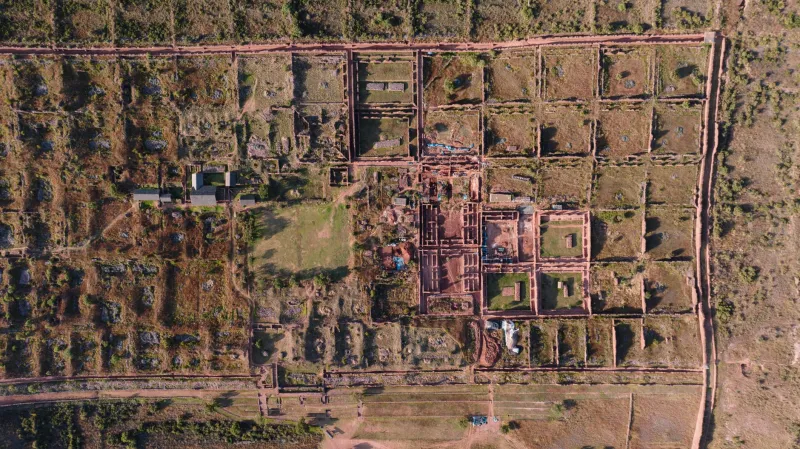
Walk the excavated lanes of Mohenjo-daro and the first impression is order: straight streets, uniform brick dimensions, drains that run where drains ought to run. Walk a little farther, though, and the impression changes. Between the well-known house blocks lie broad, flat, unremarkable expanses of ground—plots with no walls, lanes that begin and then simply stop, and whole sectors where the grid seems to have been drawn but never filled in.
Early excavators treated such areas as downtime, the ground between the finds. That was a mistake. Read carefully, the vacant plots of the lower town are as informative as any courtyard, and they raise a question that has quietly divided Indus specialists for decades: was Mohenjo-daro a finished city, or a work in progress that history interrupted?
The Anatomy of the Grid
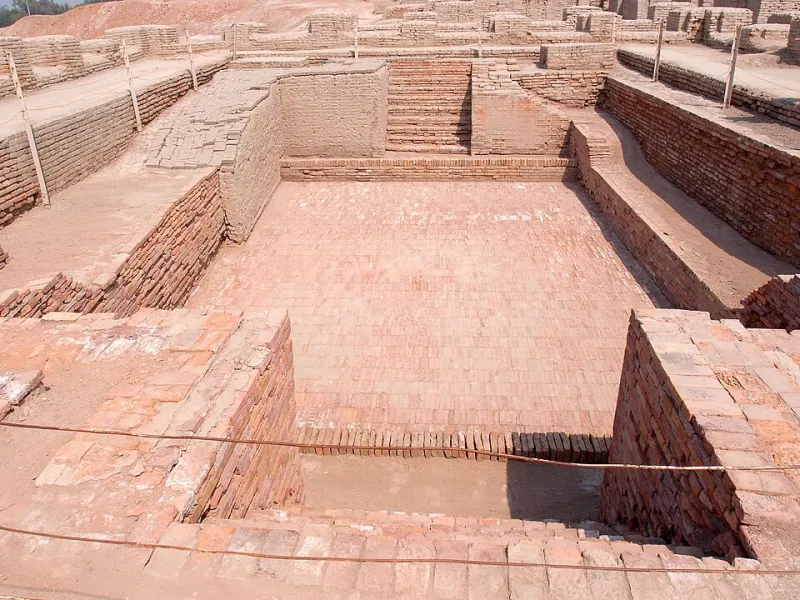
Mohenjo-daro's layout is often described in textbook terms: a raised western mound, conventionally called the citadel, and a much larger lower town to the east, both organized on roughly cardinal alignments. Streets run north–south and east–west; lanes thread between blocks of houses; the larger thoroughfares are wide enough for a cart, the smaller ones barely for a person.
What the textbooks usually omit is the irregularity. The grid is not uniform. Block sizes vary. Some thoroughfares are respected for a hundred meters and then abandoned by the buildings around them. In several sectors, excavators traced street surfaces that carried no adjacent structures at all. The plan exists, in other words, but the plan and the built city do not match exactly.
Three Ways to Read a Vacancy
An empty plot in an ancient city can mean at least three different things, and distinguishing among them is the central methodological problem.
First, it can mean a project never realized. A street may have been laid out in anticipation of growth that did not arrive within the period of occupation. This is the most interesting possibility, because it implies planning ahead of demand—municipal or communal foresight rather than incremental sprawl.
Second, it can mean erasure. Brick is a recyclable material. The nineteenth-century reuse of baked brick from the site for railway ballast is well documented, and later looting and agricultural disturbance took a further toll. A plot that looks vacant today may once have held a substantial structure whose bricks were carried off. Sir John Marshall's excavations in the 1920s and Ernest Mackay's work in the following years also removed later-phase walls to reach earlier levels, flattening the stratigraphic record in ways that can mimic emptiness.
Third, it can mean reorganization. Portions of the city were rebuilt repeatedly. Houses were raised on new plinths, walls were realigned, and some areas appear to have been cleared and reoccupied on a different plan. The lower town was not a single frozen design but a sequence of decisions, and some of the decisions involved demolition.
Separating these three causes requires evidence that early excavators did not collect: microstratigraphy, geophysical survey, and careful study of the surfaces beneath the bare ground. Michael Jansen's documentation work in the 1970s and 1980s, which treated mud-brick architecture as a primary record rather than an obstacle, moved the conversation in that direction. Modern remote sensing has extended it.
What a Partly Built City Implies
If even a fraction of the lower town's gaps represent unbuilt plans, the implications are substantial. It would mean that Mohenjo-daro's celebrated regularity was a framework, not a completed fact—an infrastructure of streets and drainage into which buildings were inserted over time, at varying rates, by varying households.
American planners have a familiar term for this pattern: staged development. It is what happens when a subdivision lays down roads and utilities for four hundred homes and builds eighty. The comparison is not frivolous. Planned company towns such as Pullman, Illinois, and the mass-produced suburbs of the mid-twentieth century were both designed as complete systems and both, in practice, filled in unevenly. After the 2008 housing collapse, subdivisions across the American South and Southwest were left with finished streets, installed pipe, and no houses—temporary vacancies that became permanent ones.
Mohenjo-daro, at roughly four and a half thousand years' remove, presents the same phenomenon in brick and mud. The difference is that the Indus city had no single developer to go bankrupt. Whatever authority laid out the streets, the filling-in appears to have been a matter of household initiative, constrained by rules about drainage, wall alignment, and the sanctity of the street line.
Slack as a Design Feature
The most useful lesson for contemporary planning may be about slack. A city that leaves room for later construction, for reconfiguration, for uses not yet imagined, is more resilient than one built to full capacity on day one. Archaeologists who assume that the excavated footprint equals the inhabited city will systematically overestimate density and underestimate the city's capacity for change.
The corollary is a caution. Empty space in the archaeological record is not automatically meaningful. Some of it is silence, some of it is damage, and some of it is the shadow cast by the tools of an earlier generation of excavators. The vacancy is a question, not an answer.
A City That Was Still Deciding
What emerges is a picture less tidy than the one on museum panels. Mohenjo-daro was designed, undeniably—the alignments, the drains, and the standardization of brick dimensions all testify to forethought. But it was also unfinished, amended, repaired, and partially abandoned well before its final decline. The empty plots are the physical residue of those decisions, made by people whose names we will never recover.
For visitors, the practical advice is simple: look at the gaps as carefully as the walls. For planners and students of cities, the larger point is that a grid is a promise, and a promise is not a guarantee. Mohenjo-daro kept some of its promises and quietly broke others, leaving the evidence on the ground for anyone willing to read a blank space as a sentence.